When I took my first steps into the world of Champagne, I kept stumbling upon terms like "Grand Cru" and "Premier Cru" on labels. What initially looked like a simple quality promise turned out to be a fascinating, century-old system for evaluating Champagne terroirs.
What is the Échelle des Crus?
The Échelle des Crus (Cru ladder) is a historic classification system that evaluates the 319 wine-growing villages of Champagne according to their quality. It was developed at the beginning of the 20th century to ensure fair grape prices between growers and Champagne houses.
The system originally functioned like a price matrix: Each village received a rating between 80 and 100 percent. This percentage directly determined the price that Champagne houses had to pay for grapes from that village.
The three quality levels
My posts about it

Wenn der Morgen mit Champagner und Kaviar beginnt, dann kann das eigentlich nur ein guter Tag werden. Der purste Moment ist oft der stärkste.…

Zum Grillhendl gab es gestern @champagnejacquesbusin – Vieilles Vignes: Rotisserie-Huhn mit Kartoffelpüree, gegrilltem Mais und Brokkoli – ein…

Manchmal sind es die kleinen Details, die im Gedächtnis bleiben: Unter der Folie des @champagne_franck_bonville – Brut Grand Cru Blanc de Blancs…
| Classification | Rating | Number of Villages | Meaning |
|---|---|---|---|
| Grand Cru | 100% | 17 | Highest quality level |
| Premier Cru | 90-99% | 42 | Second highest quality level |
| Other Crus | 80-89% | 260 | Remaining villages |
The 17 Grand Cru Villages: Elite Terroirs of Champagne
Only 17 villages may adorn themselves with the coveted 100-percent status. This selection is no coincidence – they represent the absolute top sites of Champagne:
Côte des Blancs (Chardonnay stronghold)
- Avize – The heart of the Côte des Blancs
- Cramant – Elegant, mineral Chardonnays
- Le Mesnil-sur-Oger – Home of legendary Blanc de Blancs
- Oger – Fine, delicate Chardonnay expression
- Oiry – Smallest Grand Cru village
Montagne de Reims (Pinot Noir domain)
- Ambonnay – Powerful Pinot Noirs
- Beaumont-sur-Vesle – Structured, age-worthy wines
- Bouzy – Famous for red still wines and Pinot Noir
- Louvois – Elegant balance between power and finesse
- Mailly-Champagne – Cooperative stronghold
- Puisieulx – Small but fine village
- Sillery – Historically significant, rather rare today
- Verzenay – Complex, multi-layered Pinot Noirs
- Verzy – Structured, mineral wines
Vallée de la Marne
- Aÿ – Legendary Pinot Noir site, home of Dom Pérignon
- Tours-sur-Marne – For both Pinot Noir and Chardonnay
Côte de Sézanne
- Chouilly – Only Grand Cru for Chardonnay in this zone
The 42 Premier Cru Villages: Second League with World-Class Potential
The Premier Cru villages with 90-99% ratings include many names that are well known to Champagne lovers. These include Hautvillers (the legendary home of Dom Pérignon), Mareuil-sur-Aÿ, Dizy or Rilly-la-Montagne.
This classification already shows an important insight: Premier Cru by no means indicates inferior quality. Many of the world's best Champagnes come from Premier Cru sites.
Why the system is less relevant today
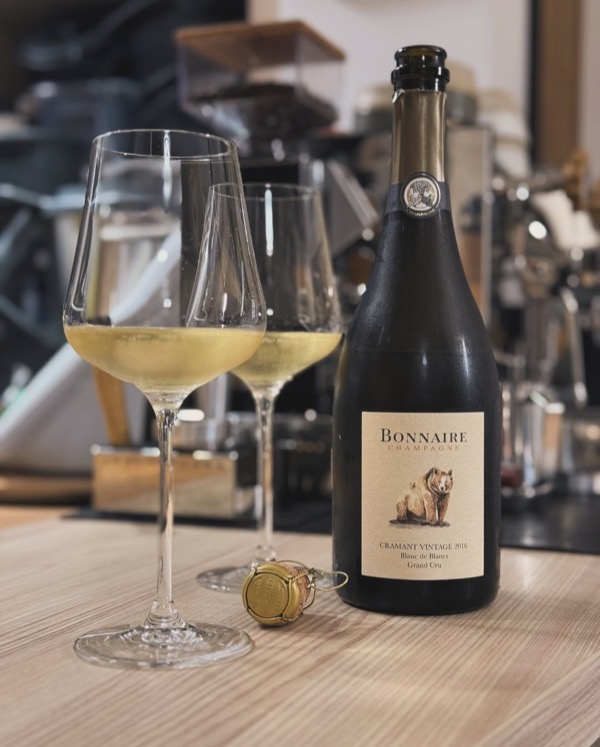
Diese Woche kam eine frische Lieferung direkt aus der Champagne bei mir an – Drei spannende Flaschen von @bonnaireclouet . Für den Auftakt habe ich…

Heute gibts den 1000% Pinot Noir von @champagne_herbertandco . Von diesem kleinen, feinen Haus (geführt von @thomas___herbert und @charlottehbrt_ in…

Wer 100 % Chardonnay liebt, kommt an den Grand-Cru-Lagen von Cramant an der nördlichen Côte des Blancs nicht vorbei. Das Dorf ist berühmt für Weine…
Market development overtakes historic price matrix
The original pricing system of the Échelle des Crus was largely abandoned in the 1990s. Today, growers and Champagne houses negotiate individual contracts – often based on quality, demand and personal relationships rather than rigid percentages.
Terroir is more complex than village boundaries
A crucial point of criticism: Quality doesn't just depend on the village, but on specific parcels, microclimate, slope inclination and winemaking work. Within a Grand Cru village there are certainly mediocre sites, while top terroirs can be found in "normal" villages.
Marketing tool vs. quality reality
Today many producers use the Cru classification primarily as a marketing tool. A Grand Cru on the label justifies higher prices – regardless of whether the respective Champagne is actually better than one from Premier Cru grapes.
Why the system can still be a quality indicator
Historically grown reputation
The Grand Cru and Premier Cru villages were not chosen arbitrarily. Centuries of winemaking history and market experience flowed into this evaluation. The geological and climatic conditions of these sites are indeed often exceptional.
Guidance for consumers
For Champagne beginners, the Cru system offers valuable orientation. A Grand Cru Champagne is not automatically better than any other, but the probability of high quality is statistically higher.
Basis for premium cuvées
The best Champagne houses use Grand Cru and Premier Cru grapes specifically for their prestige cuvées. Here the classification makes perfect sense, since only the best base wines are used for these top Champagnes.
My conclusion as The Champagne Guy
Champagne's Cru system is a fascinating historical relic that today more than ever must be viewed with nuance. While it has outlived its usefulness as a rigid pricing system, it remains a useful – if not infallible – quality indicator.
My recommendation: Use the Cru classification as orientation, but don't let it be the sole deciding factor. The best Champagne is ultimately the one that tastes good to you – regardless of whether it comes from Grand Cru, Premier Cru or other villages.