Remuage: The Centuries-Old Art of Champagne Riddling
When I first stood in a champagne cellar and saw the endless rows of bottles positioned at an angle in the traditional pupitres, I wasn't yet aware of the precise craftsmanship behind this sight. Remuage – the daily turning and tilting of bottles – is one of the most fascinating and labor-intensive steps in champagne production.
What is Remuage and why is it necessary?
After the second fermentation in the bottle, a fine sediment of lees forms, which settles at the bottom of the horizontal bottle. This sediment must be completely moved into the bottle neck so it can later be removed during dégorgement. Remuage makes exactly this possible: through systematic turning and gradual tilting, the yeast collects in the bottle neck.
The Traditional Method: Hand Remuage on Pupitres
Structure and Function of Pupitres
Traditional pupitres are ingeniously simple in construction: two rectangular wooden boards are set up at an angle of about 45 degrees to each other and connected by crossbeams. Round holes are drilled into these boards – 60 per pupitre – just large enough to hold a champagne bottle.
The Workflow of the Rémeur
An experienced rémeur can handle up to 40,000 bottles daily. This sounds like an impressive number, but behind it lies years of practice and a fascinating rhythm:
Week 1-2: The bottles start nearly horizontal. The rémeur turns each bottle about one-eighth (45°) and tilts it minimally.
Week 3-4: The tilt is continuously increased while the turning movements continue.
Week 5-6: The bottles stand almost vertical (sur pointe), the sediment has completely collected in the bottle neck.
Time Investment and Precision
The entire remuage process traditionally takes 6-8 weeks. Every day, each bottle must be moved – this means hundreds of thousands of precise hand movements for larger production. An experienced rémeur develops an almost intuitive feel for the condition of each individual bottle.
The Modern Alternative: Gyropalette
Technical Innovation from the 1970s

Nach dem stressigen Freitag und einer kleinen Halloween-Party war gestern Abend einfach Stille angesagt. Dazu die erste Flasche aus einem breiten…
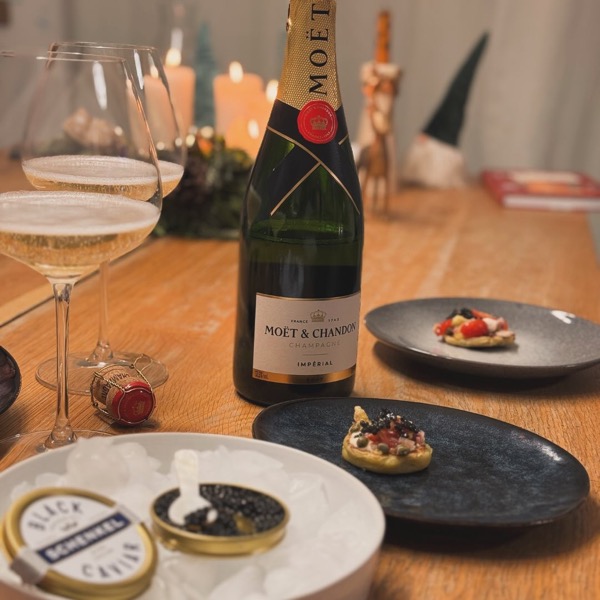
Manchmal braucht es keine große Inszenierung, um echten Luxus zu erleben – nur einen guten Black Imperial Stör Kaviar von @schenkeldelikatessen ,…

Alles beginnt jetzt! 🥂 Wirklich begonnen hat alles aber vor rund drei Jahren, als ich zum ersten Mal bewusst einen Champagner genießen durfte. Wie…
In 1976, the invention of the gyropalette revolutionized the champagne industry. These automated cages can hold 504 bottles simultaneously and perform the turning and tilting movements under computer control.
Comparison of Both Methods
| Aspect | Hand Remuage | Gyropalette |
|---|---|---|
| Duration | 6-8 weeks | 7-10 days |
| Labor Requirements | High | Minimal |
| Precision | Individually adaptable | Standardized |
| Capacity | 40,000 bottles/day/person | 504 bottles/cycle |
| Costs | Labor-intensive | Investment-intensive |
The gyropalette is undoubtedly more efficient: it reduces remuage time by about 80% and eliminates the enormous labor requirements. But is more efficient automatically better?
Why Some Winemakers Stick with Hand Remuage
The Philosophy of Individuality
When I speak with tradition-conscious champagne producers, I hear the same argument repeatedly: every bottle is an individual. The yeast distribution, the wine's clarity, the specific characteristics of each batch – an experienced rémeur can sense all of this and react accordingly.
Quality Aspects of Hand Remuage
Gentler Treatment: The human hand can instinctively adjust the intensity of movement. With problematic bottles, the rémeur can proceed more carefully.
Individual Assessment: A rémeur immediately recognizes when a bottle reacts differently than expected and can act accordingly.
Longer Maturation: The 6-8 weeks of remuage time also means longer contact with the lees, which can lead to more complex aromas.
Tradition as Marketing Advantage
Many smaller champagne houses consciously use hand remuage as a quality feature. It's a visible sign of craftsmanship and tradition – values that are appreciated in today's automated world.
Which Method is Better?
After years of engagement with this topic, I've come to the conclusion: it depends. Large houses with millions of bottles cannot survive without gyropalettes. The quality doesn't necessarily suffer – the technology is mature and precise.
For smaller producers or prestige cuvées, hand remuage makes perfect sense. It's part of the philosophy and quality promise. As a champagne enthusiast, I appreciate both approaches: the perfected efficiency of modernity and the venerable craftsmanship of tradition.
Remuage remains a fascinating process – whether executed by human hands or mechanically. It reminds us that champagne isn't simply sparkling wine, but the result of centuries-old expertise and infinite patience.